Article III · Libraries & Collections · Clause 3.3
A Mile of Shelving Per Year
The books keep arriving. The building does not grow. How research libraries solved — and did not solve — the engineering problem of infinite accumulation.
- Instrument
- Clause 3.3
- Filed under
- Libraries & Collections
- Schedules attached
- 2
- Reading
- 4 min
The Weight of Knowledge Is Literal
A fully loaded library stack weighs somewhere between 150 and 300 pounds per square foot — three to six times the load a standard office floor is designed to bear. That fact, more than any aesthetic preference, explains why research library buildings look the way they do. The monumental exteriors, the thick masonry piers, the windowless middle sections of mid-century towers: nearly all of it traces back to the floor.
Early university libraries did not anticipate the problem. Harvard's Gore Hall, opened in 1838 as a Gothic Revival showpiece, filled its reading alcoves within a generation. Yale's original library building ran out of room before the Civil War. The research library as a distinct architectural type — engineered from the slab up for continuous, compressive loading — did not exist until the 1870s, when Harvard commissioned a cast-iron stack building behind Gore Hall. The stacks were structural: the iron tiers carried themselves and the books, while thin glass floors let light fall between levels. It was a building within a building, and it was immediately imitated.
The Compact Shelving Problem
A large research library acquires books faster than it can rehouse them. The Association of Research Libraries has documented member institutions adding hundreds of thousands of volumes in a single year — hence the shorthand of a "mile of shelving" as a rough unit of annual growth. Conventional fixed shelving addresses the density problem only modestly. Mobile compact shelving — units that roll on floor-mounted tracks, collapsing the aisle between them until a reader needs access — roughly doubles the storage capacity of a given footprint. But the floor load problem gets worse: compacted shelving concentrates weight into a smaller area. Buildings designed for fixed stacks must be reinforced, sometimes at considerable expense, before compact systems can be installed.
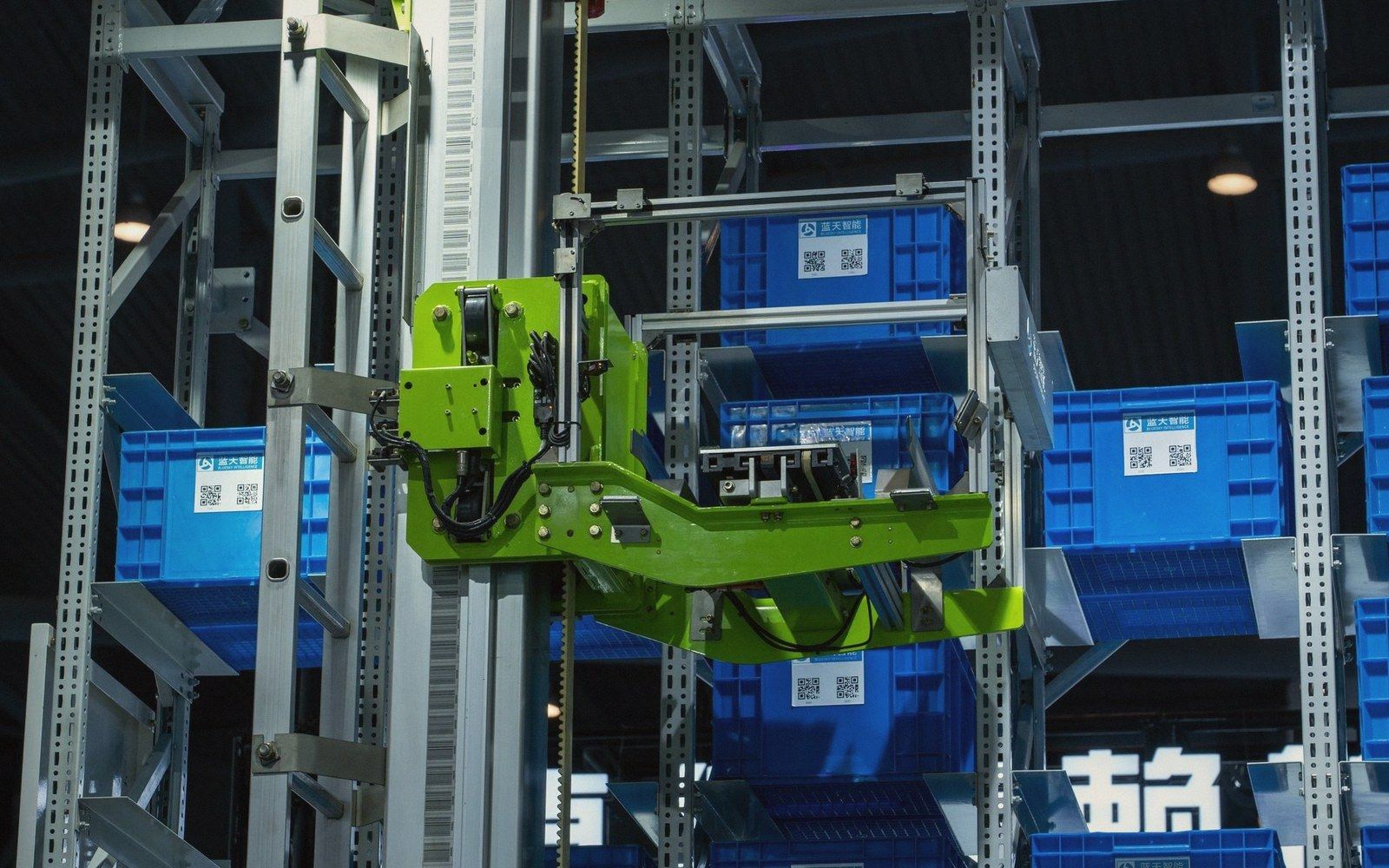
The engineering constraint pushed several institutions toward a more radical solution: the high-bay automated storage and retrieval system. In these facilities, books are catalogued by size rather than subject, slotted into bins inside a climate-controlled vault, and retrieved by a robotic crane. Harvard's Depository in Southborough, Massachusetts, opened in 1986 as one of the first at scale; the University of California's Northern Regional Library Facility had opened a few years earlier. Neither building looks like a library. They look like distribution warehouses — because functionally, they are.
Architecture Follows Logistics
The off-site repository changed the design calculus of the campus library itself. Once a research library could confidently offload low-use volumes to a climate-controlled facility a truck-ride away, the main building could devote its expensive urban square footage to reading rooms, digital infrastructure, and special collections. The underground extension — excavated beneath a courtyard, out of sight — became another favoured solution at crowded campuses: Columbia, Yale, and Stanford have all put stacks below grade, trading construction cost against the impossibility of growing upward in a dense historic precinct.
What these solutions share is an acknowledgment that the physical collection is a logistics system, not just a cultural one. The two buildings that share the name "library" on a modern campus have almost nothing in common as engineering problems. A lending library holds a managed, curated circulation stock. A research library holds everything — in perpetuity, or close to it — and "everything" has mass, and mass requires structure.
The mile of shelving added each year does not slow down. What changes is where that shelving sits: underground, off-campus, or inside a robot vault that no reader ever enters. The books are still there. The building just learned to hide where it keeps them.
Also in Libraries & Collections
Related clauses